

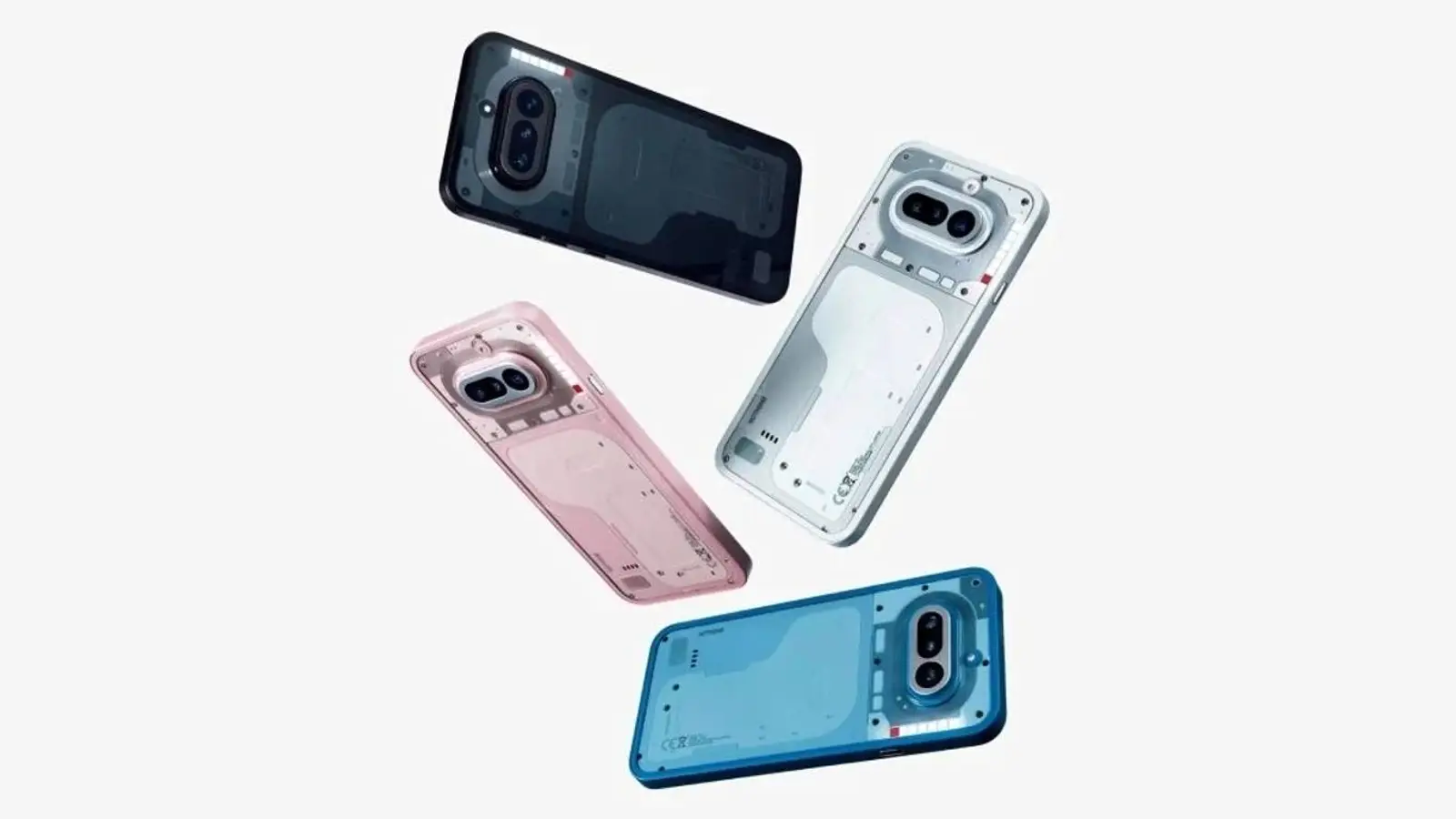
Nothing has officially unveiled the Nothing Phone (4a) and Nothing Phone (4a) Pro, focusing on distinct design approaches and an upgraded rear lighting system.
The base model features a more streamlined body with a pill-shaped camera module and the new Glyph Bar lighting strip. This direct LED strip contains 63 LEDs divided into six segments, includes a red recording indicator, and reaches a peak brightness of up to 3,500 nits, which is roughly 40% higher than the previous generation. The phone runs Nothing OS 4.1 based on Android 16, with the manufacturer promising three major OS updates and six years of security patches. Inside, it uses the Snapdragon 7s Gen 4 chip, offering a performance increase of about 7% over the prior version, paired with 8 or 12 GB of LPDDR4X RAM and up to 256 GB of UFS 3.1 storage.
For the display, it sports a 6.78-inch OLED panel with a resolution of 1,224 by 2,720 pixels, a 120 Hz refresh rate, and a peak brightness of 4,500 nits, protected by Gorilla Glass 7i. The main camera setup relies on a 50 MP Samsung GN9 sensor with optical image stabilization, complemented by a 50 MP periscope lens with 3.5x optical zoom, an 8 MP ultra-wide module, and a 32 MP front camera. The body is plastic, 8.55 mm thick, with an IP64 rating and a 5,080 mAh battery supporting 50 W charging. Pre-orders are now open, with sales set to begin on March 13 starting at 350 euros.
The Pro version boasts a bolder appearance and the Glyph Matrix system—a circular LED display with 137 LEDs on the back. Despite having fewer LEDs than the flagship Nothing Phone (3), this new matrix is about 57% larger and achieves a brightness of 3,000 nits. The phone is built with a unibody metal chassis that is 7.95 mm thick and has an IP65 rating. Performance comes from the Snapdragon 7 Gen 4 chip, which delivers up to a 27% CPU boost, 30% in graphics, and 65% in AI tasks compared to the previous generation. It uses 8 or 12 GB of LPDDR5X RAM and 128 or 256 GB of UFS 3.1 storage, with cooling handled by a 5,300 mm² vapor chamber.
The Pro display is a 6.83-inch OLED panel with a resolution of 1,260 by 2,800 pixels, a 144 Hz refresh rate, a peak brightness of 5,000 nits, and 2,160 Hz PWM dimming. The main camera is based on a 50 MP Sony Lytia 700C sensor with OIS, paired with a 50 MP Samsung JN5 periscope lens offering 3.5x optical zoom, along with an 8 MP Sony IMX355 ultra-wide camera with a 120-degree field of view and a 32 MP front camera. The battery remains the same at 5,080 mAh with 50 W charging support. Pre-orders start on March 13, with sales beginning on March 27, marking the model's first official availability in the United States. Pricing starts at 480 euros and can reach up to 600 euros depending on the configuration.