
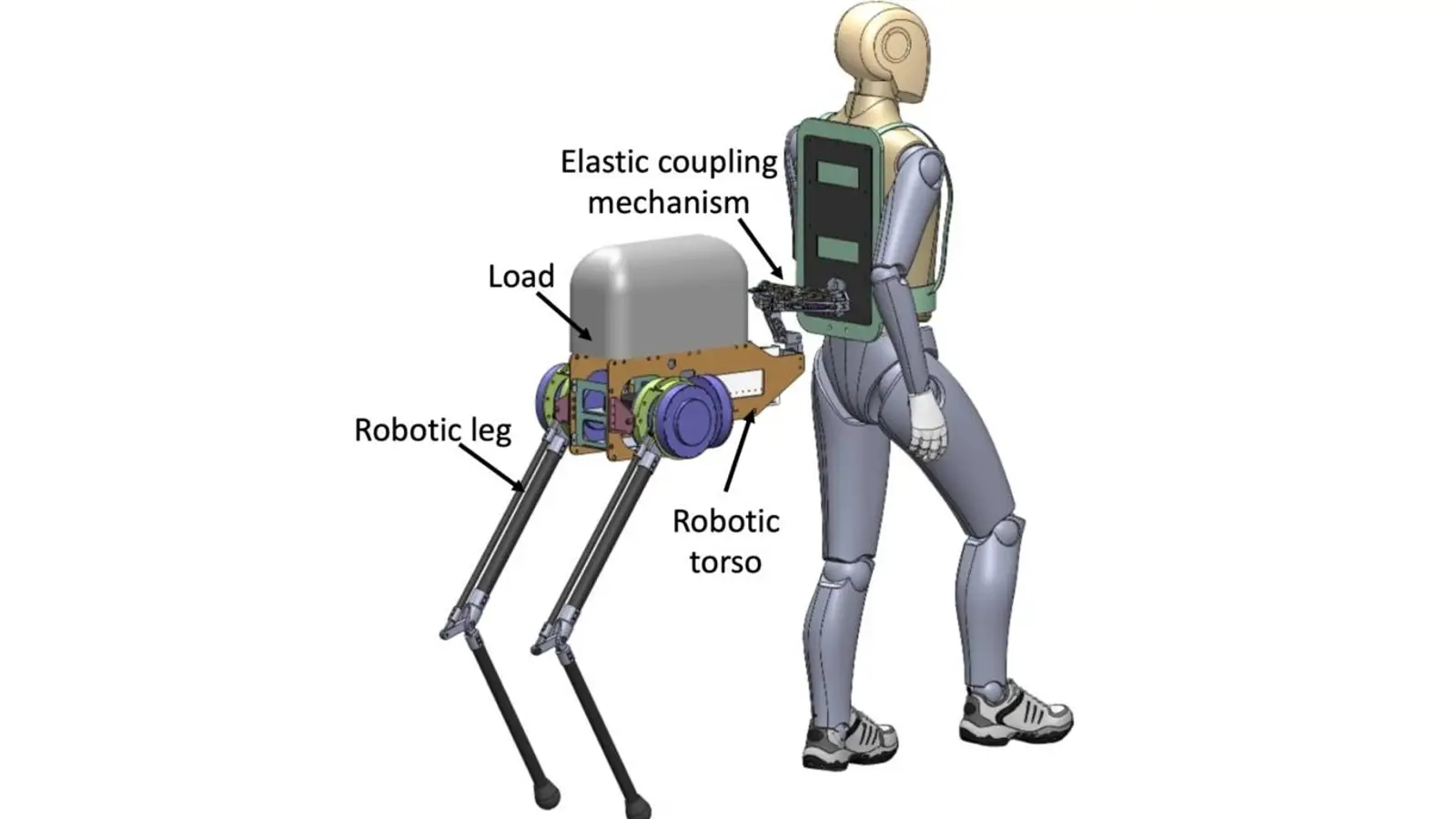
A team led by Professor Fu Chenglong from the Southern University of Science and Technology (SUSTech) has unveiled a new wearable system designed to assist with carrying heavy loads. Dubbed the "half-human, half-robot" or "centaur robot," the development was published in the reputable International Journal of Robotics Research. This device aims to reduce the strain on humans during prolonged walking with weight, making it suitable for military, rescue operations, and everyday tasks.
Unlike traditional exoskeletons that operate parallel to human legs and offer relatively modest energy savings—around 10% compared to a regular backpack—this system takes a different approach. The robot isn't rigidly attached to the legs but functions as a separate "pair of limbs" connected to the user through a special elastic interface on the back. This setup creates a hybrid four-legged system where the human handles navigation and decision-making, while the robot takes on weight-bearing and provides horizontal traction.
A key innovation is the team's elastic coupling with nonlinear stiffness. Under light loads, it remains stiff and responsive, but with heavier loads, it becomes more compliant and absorbs force. This allows for a dynamic separation between balancing and power assistance, enabling the robot to move stably as an independent system while precisely aiding the human.
Tests have shown impressive results: when carrying 20 kg (about 29% of body weight), using the "centaur" reduced net metabolic costs by 35% and foot pressure by 52%. Step width variability also decreased, and walking stability proved comparable to moving without a load. This development highlights how combining vertical weight redistribution with horizontal traction can significantly enhance efficiency and safety in heavy-load transport.