
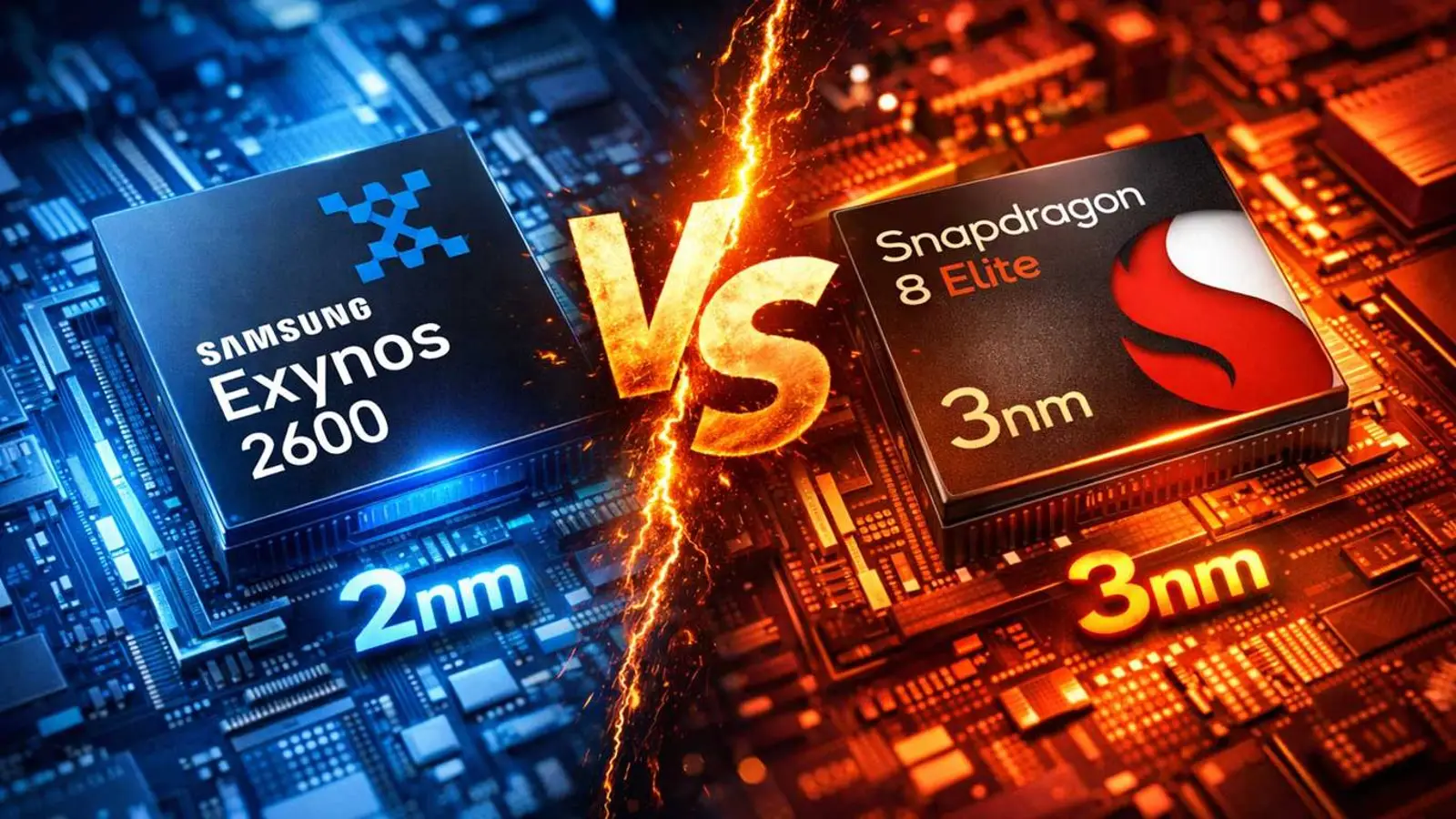
Samsung has made a serious statement about returning to the mobile processor race with the launch of the Exynos 2600. This isn't just another line update—it's the industry's first mobile chip built on a 2nm process with GAA architecture. The main question is whether it can outpace one of the market's strongest competitors, the Snapdragon 8 Elite.
Architecture and Technology: 2nm vs. 3nm
The Exynos 2600 is manufactured using Samsung's 2nm process, while the Snapdragon 8 Elite is built on TSMC's 3nm (N3E) node. In theory, the thinner process offers advantages in energy efficiency and stable performance.
The Exynos 2600 features a ten-core processor with one C1-Ultra core at 3.8 GHz, three C1-Pro cores at 3.25 GHz, and six C1-Pro cores at 2.75 GHz. The Snapdragon 8 Elite uses an eight-core configuration with two second-generation Oryon cores at 4.32 GHz and six cores at 3.53 GHz. Despite Qualcomm's higher peak frequency, Samsung is betting on a greater number of cores.
Graphics in the Exynos are handled by the Xclipse 960, which supports ray tracing and Exynos Neural Super Sampling technology for intelligent upscaling. The Snapdragon uses the Adreno 830 with Ray Tracing support and the Snapdragon Elite Gaming feature set. Both chips are equipped with advanced neural units: the Exynos has an AI engine with a 32K MAC NPU, while the Snapdragon features a Hexagon NPU.
Test Results: A Minimal but Important Edge
In Geekbench 6, the Exynos 2600 scored 3,040 points in the single-core test against the Snapdragon 8 Elite's 3,008. The gap widened in the multi-core test, with 10,290 points versus 9,730, giving about a 6% advantage.
In AnTuTu 11, the Exynos showed 3,210,573 points, while the Snapdragon scored 3,162,650. Notably, the Exynos's CPU performance was about 10% higher, graphical performance was nearly equal, and the Snapdragon led in the user experience test.
In 3DMark Wild Life Extreme, the Exynos scored 6,674 points, and the Snapdragon scored 6,527. The difference is small, and much depends on the cooling system of a specific smartphone, but formally Samsung comes out ahead.
Cameras and AI
The Exynos 2600 supports cameras up to 320 MP, 8K video recording, and dual configurations up to 64 + 32 MP. Its new Visual Perception System integrates computer vision directly into the ISP, enabling real-time scene analysis and semantic segmentation.
The Snapdragon 8 Elite uses an 18-bit Spectra ISP with support for triple AI-ISPs, unlimited 4K segmentation, object removal tools from video, and intelligent skin and sky processing. Both solutions offer powerful tools, but Qualcomm is traditionally known for stable performance in photo and video.
Connectivity and Modems
The Exynos 2600 is equipped with the Exynos 5410 modem, supporting mmWave and sub-6 GHz. Maximum download speeds reach 14.79 Gbps, and upload speeds reach 4.9 Gbps. The Snapdragon 8 Elite with the X80 modem provides up to 10 Gbps download and 3.5 Gbps upload. Both support Wi-Fi 7 and Bluetooth 6.0, but Samsung looks more convincing in terms of maximum speeds.
Conclusion
In all conducted tests, the Exynos 2600 turned out to be slightly faster than the Snapdragon 8 Elite, though the gap can't be called dramatic. Nevertheless, the move to a 2nm process and new architecture allowed Samsung to pull ahead in CPU performance and networking capabilities.
Snapdragon remains an extremely strong player with powerful graphics and a mature optimization ecosystem, but the Exynos 2600 no longer looks like a compromise option. In 2026, the battle of flagship chips has become truly equal, and the choice will increasingly depend not on dry numbers, but on how the smartphone manufacturer tunes the system as a whole.