
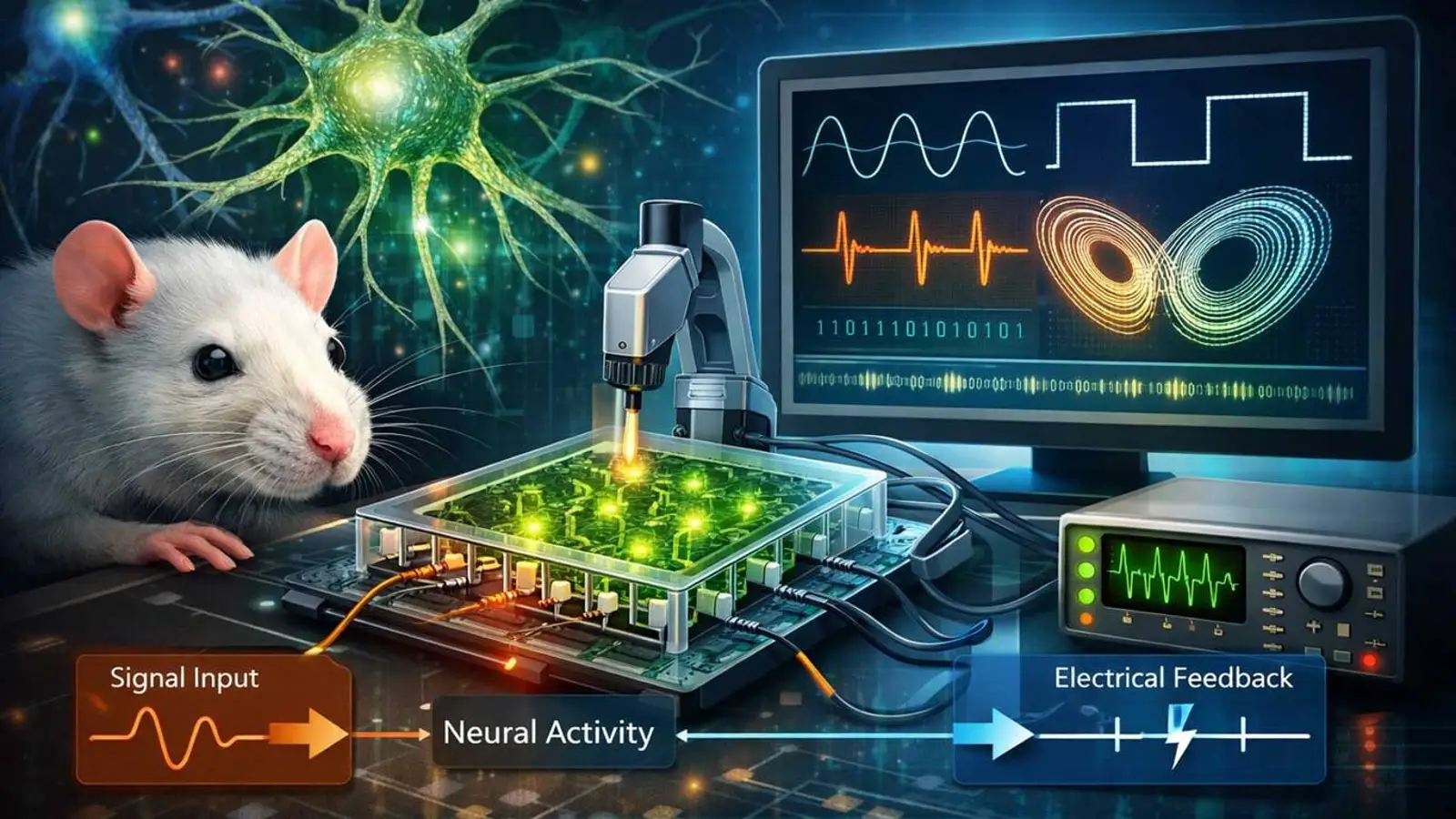
Scientists have taken a significant step forward in hybrid artificial intelligence by developing a system where living rat neurons perform computational tasks. The experiment is built on the idea of merging biological neural networks with machine learning methods to test whether living cells can function as full-fledged computational elements.
To achieve this, researchers used cortical neurons connected to microelectrodes and microfluidic devices. The system operates in a closed loop: neural signals are read, converted into output data, and then fed back as electrical stimulation. This cycle lasts about 330 milliseconds, enabling the system to learn in real time without external intervention.
Special attention was paid to the network's structure. Neurons were placed in 128 micropores connected by microchannels, which helped reduce excessive synchronization—a common issue in disorganized biological networks. As a result, activity correlation dropped nearly fourfold, making the system's behavior more complex and effective.
During experiments, the biological network successfully reproduced various signals, including sine, square, and triangular waves, and could approximate complex chaotic systems like the Lorenz attractor. Accuracy remained high, with correlation levels exceeding 0.8.
However, the technology is still far from practical use. After training ends, the system's accuracy declines, and feedback delays limit its ability to process rapidly changing signals. Nevertheless, researchers believe further development could lead to new brain-computer interfaces, neuroprosthetics, and biohybrid computing platforms.