
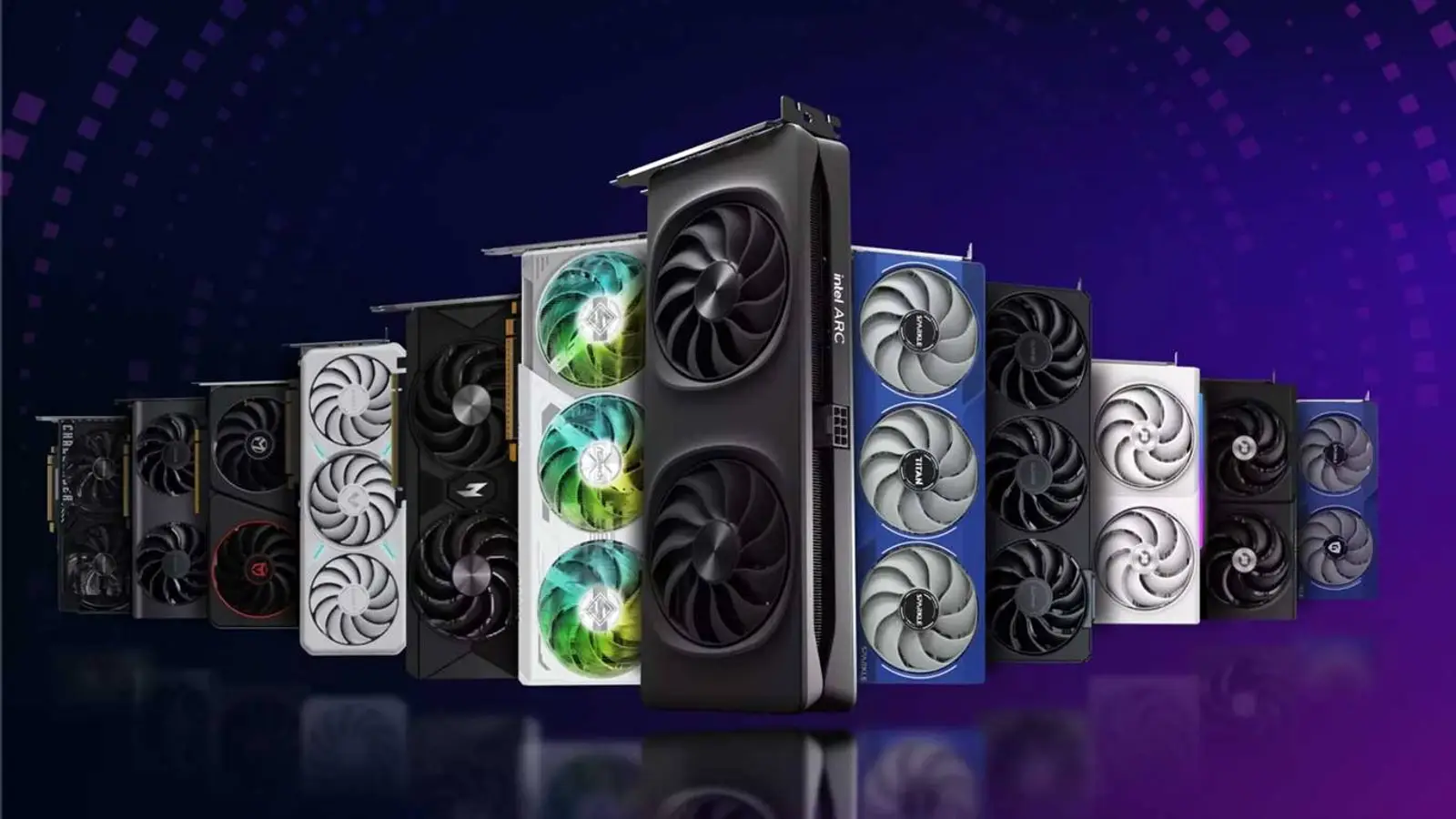
The Intel Arc Pro B70, though architected for professional and AI workloads, has been put through its paces in gaming with the latest drivers. Under the hood is the substantial Battlemage BMG-G31 die—a chip many enthusiasts had hoped to see in a gaming product, but Intel opted to deploy it first in Pro-series accelerators. These new benchmarks offer a tantalizing glimpse of what a hypothetical gaming-oriented Arc B770 could deliver.
The Pro B70 packs 32 Xe2-HPG cores, 256 XMX engines, 32 ray tracing units, and a generous 32 GB of GDDR6 memory on a 256-bit bus. The memory runs at 19 Gbps, yielding 608 GB/s of bandwidth, while the GPU clock peaks at 2,800 MHz. That VRAM buffer far outstrips typical gaming cards, but the $949 price tag reflects its professional target and the cost of 32 GB.
At 1440p rasterization, the Arc Pro B70 leaves the Arc B580 well behind. In Cyberpunk 2077, it hit 90.27 fps versus the B580's 66.02 fps and the RTX 5060 Ti 16 GB's 79.06 fps. In titles such as Black Myth: Wukong, Marvel Rivals, Monster Hunter Wilds, and Assassin's Creed Shadows, the lead over the B580 stretched to as much as 41%, though the RTX 5060 Ti generally maintained a slim edge overall.
Ray tracing paints an even more intriguing picture. In F1 25, Doom: The Dark Ages, and Cyberpunk 2077, Intel's card outpaced the RTX 5060 Ti 16 GB by roughly 9% on average, with a peak advantage of 14% in F1 25. NVIDIA held a narrow lead in the remaining titles. Measured against the Arc B580, the Pro B70 was faster by up to 65.7%, and the average uplift across RT tests landed at around 40%.
AI benchmarks underscore the card's computational muscle. In the MLPerf Client test, the Pro B70 delivered higher token generation rates and lower time-to-first-token than the RTX 5060 Ti when running Windows ML. Intel's OpenVINO support could further amplify its performance in compute-intensive tasks.
What does this mean for gamers? These numbers strongly suggest that a gaming variant of the big Battlemage could have been a serious contender in the $400–500 bracket. With 16 GB of memory and a gaming-optimized tune, such a card—call it Arc B770—would likely be 40–50% faster than the Arc B580 and capable of going toe-to-toe with the RTX 5060 Ti 16 GB. But memory supply constraints and the state of the consumer PC market make the prospect of such a model increasingly unlikely.