

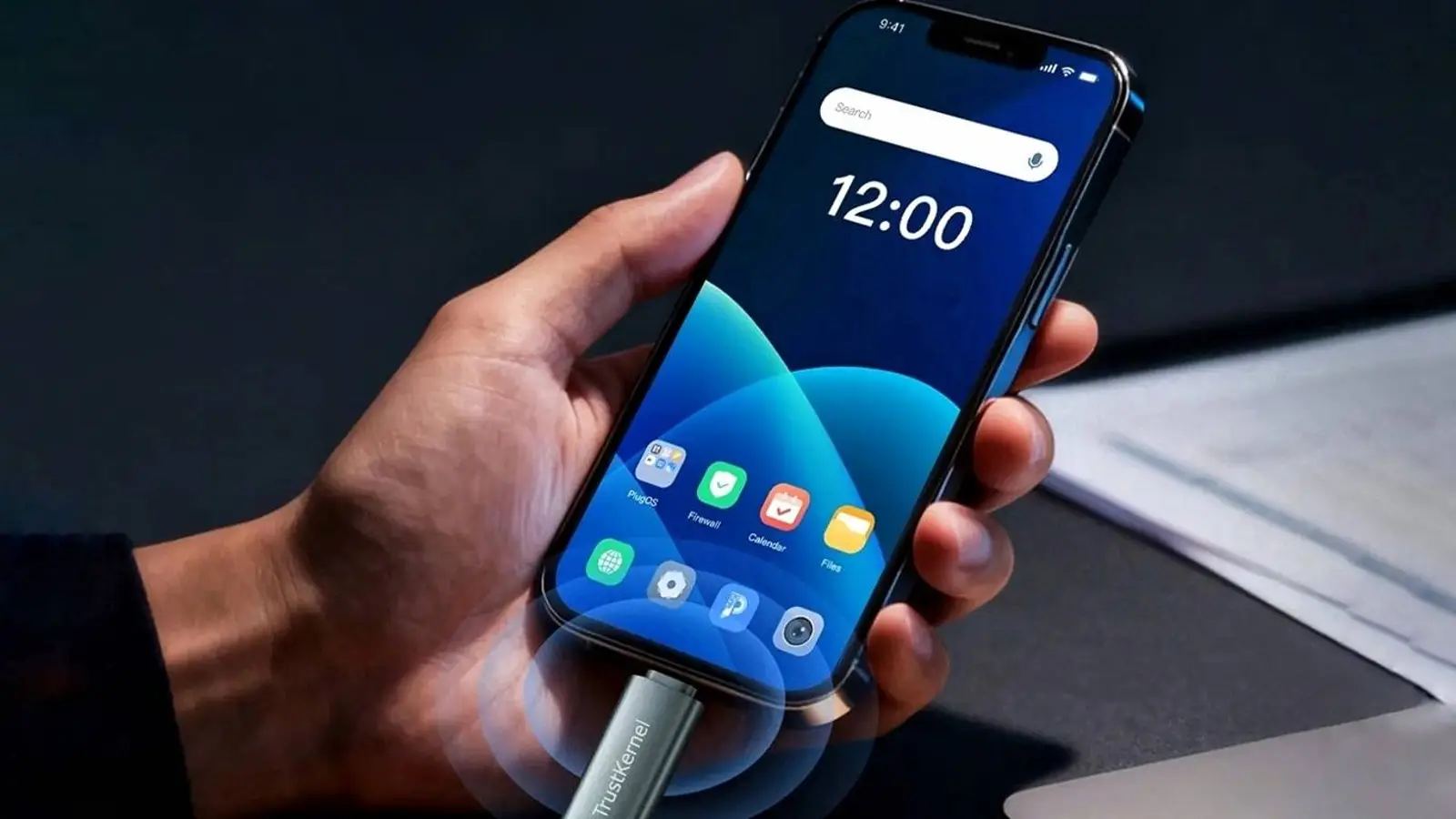
TrustKernel has officially introduced PlugOS, a security‑focused operating system based on Android and built specifically for the PlugMate device. The newcomer is a flash‑drive‑sized USB‑C mini computer that lets you run a full Android experience on a compatible host — whether that’s an iPhone, iPad, Mac, Windows PC, or an Android phone.
PlugMate operates as a standalone Android computer: all processing happens on the device itself, while the connected host simply provides power and handles input and output. All user data stays local. Think of it as an Intel Compute Stick in a smaller form factor, with security pushed to the forefront — a familiar concept, but with a sharper focus.
TrustKernel emphasizes robust data protection. PlugOS offers hardware‑based full‑disk encryption, pre‑boot authentication, and several self‑wipe modes if someone attempts unauthorized access. The device is pitched to people who need a physically isolated workspace for handling confidential information. The priorities come through clearly: isolate, encrypt, and keep the host at arm’s length.
The stick connects to iPhone, iPad, Mac, Android, and Windows. It runs on an unnamed octa‑core chip with 4 GB of RAM and 128 GB of storage, and it employs virtualized sensors to strengthen privacy. Users can install any Android apps, though heavier software may be constrained by the compact hardware — a reasonable trade‑off for portability and control.
PlugMate is priced at $299, and it’s currently on promotion for $199. For similar capabilities with fewer limitations, the manufacturer suggests considering a budget Android phone running a hardened custom ROM such as GrapheneOS — a candid nod to the device’s boundaries and to the practicality of a more traditional route.