
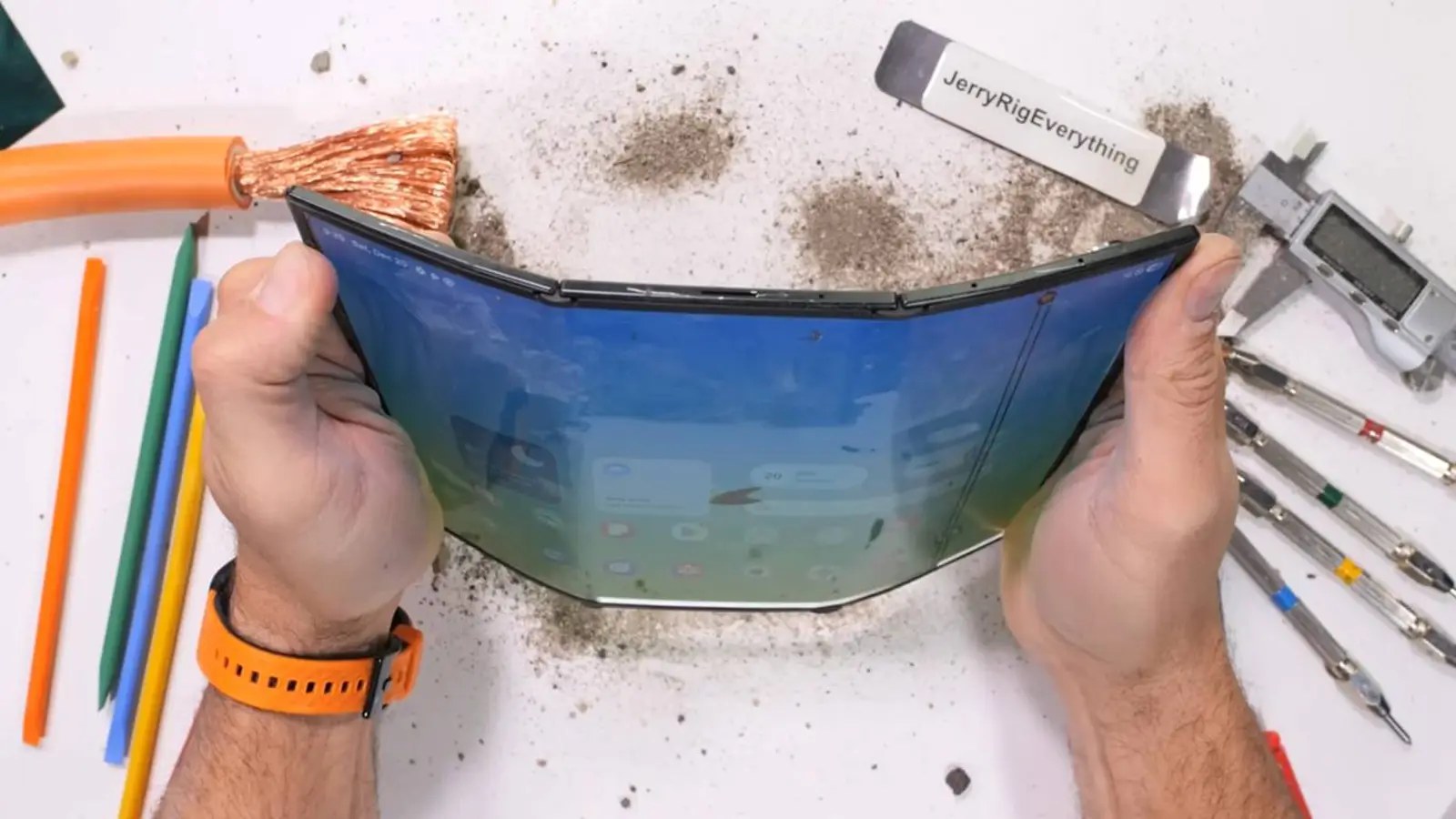
Samsung’s Galaxy Z TriFold stumbled in a punishing durability check, reminding that a more intricate folding design comes with a price. In a new JerryRigEverything video, the device failed hurdles that the Galaxy Z Fold 7 had previously survived and bowed out as soon as the bend test began.
The standard gauntlet—scratches, flame, dust, and bending—started predictably. The foldable glass still proved soft, and heat brought no surprises. The dust stage, however, quickly exposed a weak point in the TriFold. Even relatively large particles managed to work their way into the complex hinge assembly, producing a telltale crunch and grind whenever the phone opened or closed.
The turning point was the bend trial. Under comparatively moderate pressure applied in the “wrong” direction, the Galaxy Z TriFold’s display began dropping pixels, part of the panel went dark, and the lower segment of the right hinge fractured. The phone could technically still power on, but repairing the screen in that state would be prohibitively expensive—exactly the kind of failure mode that layered, moving parts tend to magnify.
By contrast, the Galaxy Z Fold 7 had endured a similar ordeal with far less damage, underscoring the durability gap between the two devices. Samsung says the TriFold is rated for 200,000 folding cycles, and prior tests did show the mechanism holding up beyond 150,000 full openings. Those numbers, though, don’t account for off-axis pressure—precisely where the TriFold showed vulnerability.
The testing also surfaced another concern that hadn’t been emphasized by the manufacturer: pressure from the outside when the phone folds inward. The updated battery removal system drew attention as well; in theory, its thin cells can flex dangerously during teardown, though in this round the device avoided any ignition. It’s a reminder that repairability features must be designed as carefully as the folding mechanism itself.