
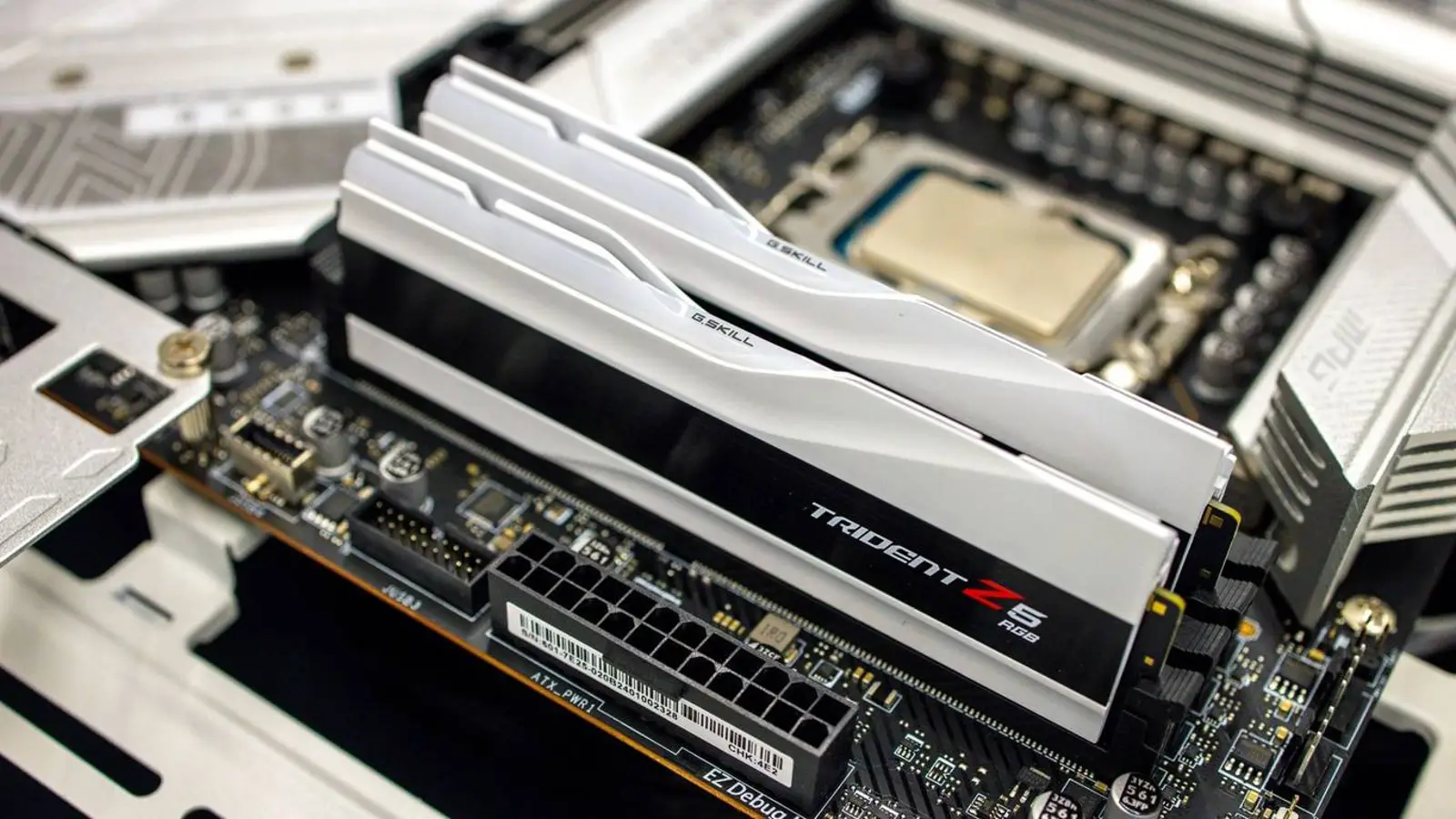
In the second half of 2025, the PC market looked relatively steady: new processors and graphics cards arrived regularly, performance kept climbing, and interest in gaming rigs held firm. But as the fourth quarter approached, the picture shifted sharply. This time the jolt didn’t come from crypto or a pandemic, but from the rapid advance of artificial intelligence. The industry has run into a DRAM “supercycle,” already driving a broad shortage of system memory and rising prices that land squarely on gamers.
Why AI is soaking up the memory
Modern AI models demand enormous compute. To process and store data, they lean on accelerators equipped with high-speed HBM memory. That HBM has become the chief consumer of DRAM manufacturing capacity. Producing a single bit of HBM requires roughly three times as many silicon wafers as a bit of standard DDR5, and its complex packaging lowers usable chip yields.
For memory makers such as Samsung and SK hynix, HBM is significantly more profitable than consumer RAM. Contracts with AI companies are getting pricier, and demand reliably outstrips supply. As a result, more production lines are shifting to HBM, HBM3E, and the next HBM4 generation, leaving the consumer DDR market undersupplied.
Data centers add more pressure
Beyond HBM, data centers are buying up DDR5 RDIMM server memory and specialized modules to ease bandwidth bottlenecks. The scale of AI cluster buildouts is so large that, by analysts’ estimates, as early as 2026 AI could account for up to 20% of total global DRAM output. That directly reduces what’s left for PCs, laptops, and gaming systems.
PC makers are raising prices
Constrained supply is forcing computer manufacturers to rethink pricing. Big brands can no longer lean on inventory to hold the line. Reports indicate that Dell is preparing substantial increases, especially for configurations with larger memory pools. Price hikes in the hundreds of dollars for systems with 32 GB—and even more so 128 GB—of RAM are becoming the new normal. ASUS, Acer, and others are moving in the same direction, and even smaller brands like Framework are already baking higher upgrade costs into their plans.
According to system integrators, 2026 could prove even more difficult. Vendors are trying to restrain price growth, but their room to maneuver is shrinking fast.
What this means for gamers
For everyday users and gamers, a DRAM shortfall brings several unwelcome side effects. First, new desktops and laptops will get more expensive. Second, manufacturers may start trimming base specifications, rolling back to 8 GB of RAM where 16 GB had recently become the norm. Third, expect possible delays for new product launches and a tightening of premium lineups.
Analysts forecast that higher memory prices will push PC shipments down by nearly 5% over the coming year, adding another drag on the market.
Should you upgrade your RAM now
Amid a shortage, the main rule is not to panic. If your system already has 8 or 16 GB and runs reliably, a rushed upgrade may be hard to justify at today’s prices. In most gaming scenarios, it’s more sensible to wait a few months than to overpay for modules.
Paradoxically, a prebuilt PC can be a better value than a DIY build right now. Large OEMs are still selling systems at prices that don’t fully reflect the memory squeeze. Another path is the used market for DDR4 and DDR5: RAM, unlike graphics cards, is less prone to wear, though deep discounts are unlikely.
A long road to normal
Current estimates suggest the shortage could persist into 2027–2028. Manufacturers plan to expand capacity, but building new fabs takes years. The market has weathered storms before—crypto booms and global supply shocks—and ultimately adapted. Odds are the AI-driven wave will recede in time; for now, though, gamers face a new reality in which system memory is both strategic and costly.