
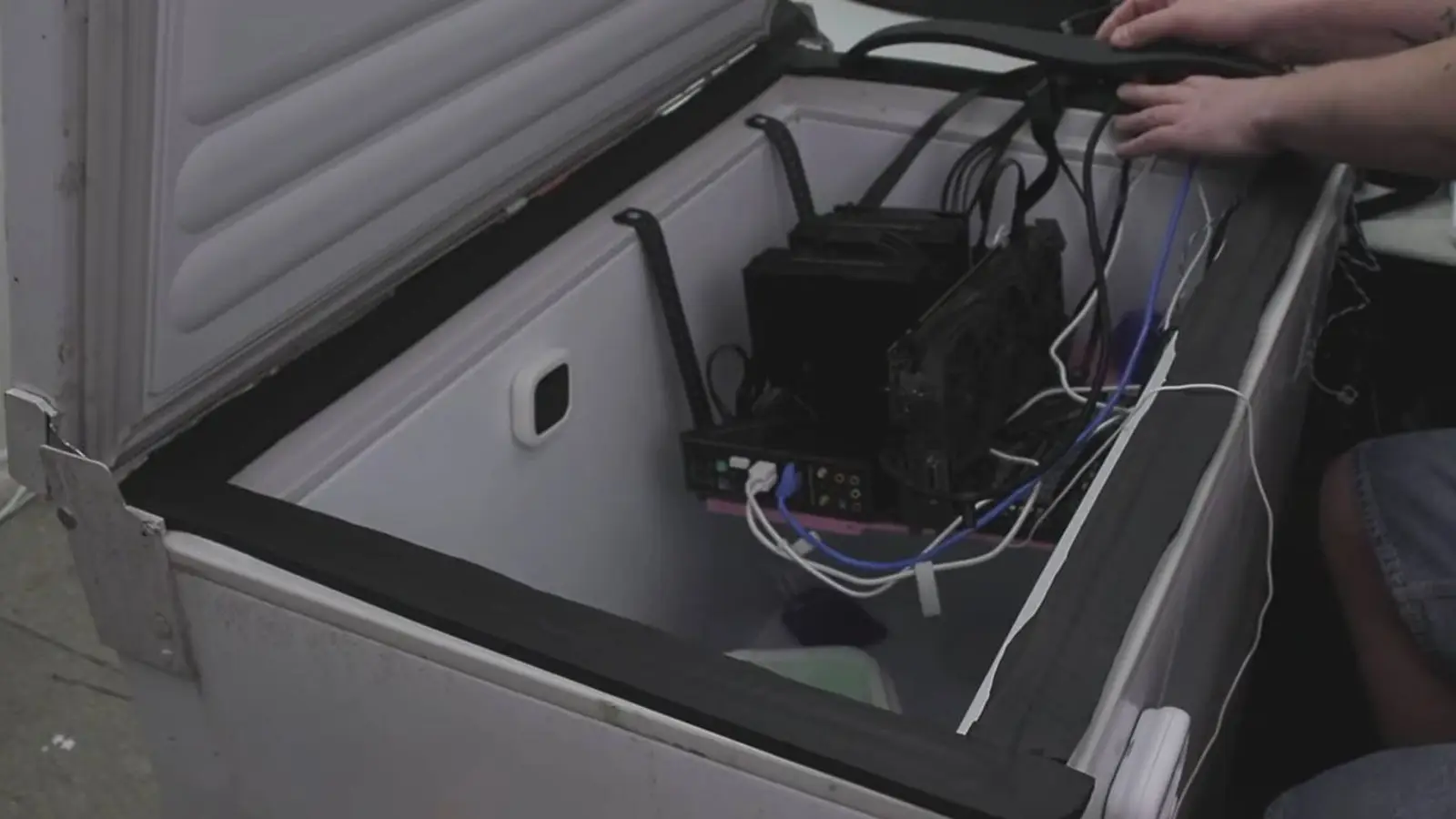
Australian modder and YouTube tinkerer TrashBench managed to pull off what has tripped up even big tech channels: he successfully booted a desktop PC inside a household freezer at –28°C, ran benchmarks, overclocked the graphics card, and removed the components dry, with no trace of condensation. The setup looked chaotic, yet it was thought through to the last detail—an instructive reminder of why most earlier “freezer PC” experiments tended to fail.
The key wasn’t extreme cold or exotic coatings, but the size of the freezer and tight humidity control. TrashBench used a large chest unit, cleared it of shelves, and suspended the components on straps so they hung in open air. The cables were routed outside and sealed, while socks stuffed with silica gel became an improvised dehumidification system. That unflashy tactic kept temperature swings gentle and avoided crossing the dew point—the moment when condensation usually forms.
For the trial, he deliberately chose older hardware—an Intel Core i7‑9700KF, a GeForce GTX 1070, and other parts from past generations. That kept heat output down and limited the downside if something went wrong. Runs in 3DMark and popular games showed that simply parking a PC in a freezer brings only a negligible performance bump, essentially within the margin of error. The real gains appeared only after manually overclocking the GPU, reaching about 7–8% in certain scenarios.
After wrapping up, TrashBench lifted the hardware out cold but completely dry. He attributed the result to the thermal inertia of a large volume of air. Unlike small freezers that warm quickly under load and invite condensation, a big chest acts as a cold reservoir, soaking up heat gradually. In such a stable environment, the silica gel has time to bring humidity down effectively. The broader lesson is that freezing a PC isn’t a miracle speed trick, but a careful, temporary negotiation with physics—where scale and patience quietly do most of the work.