
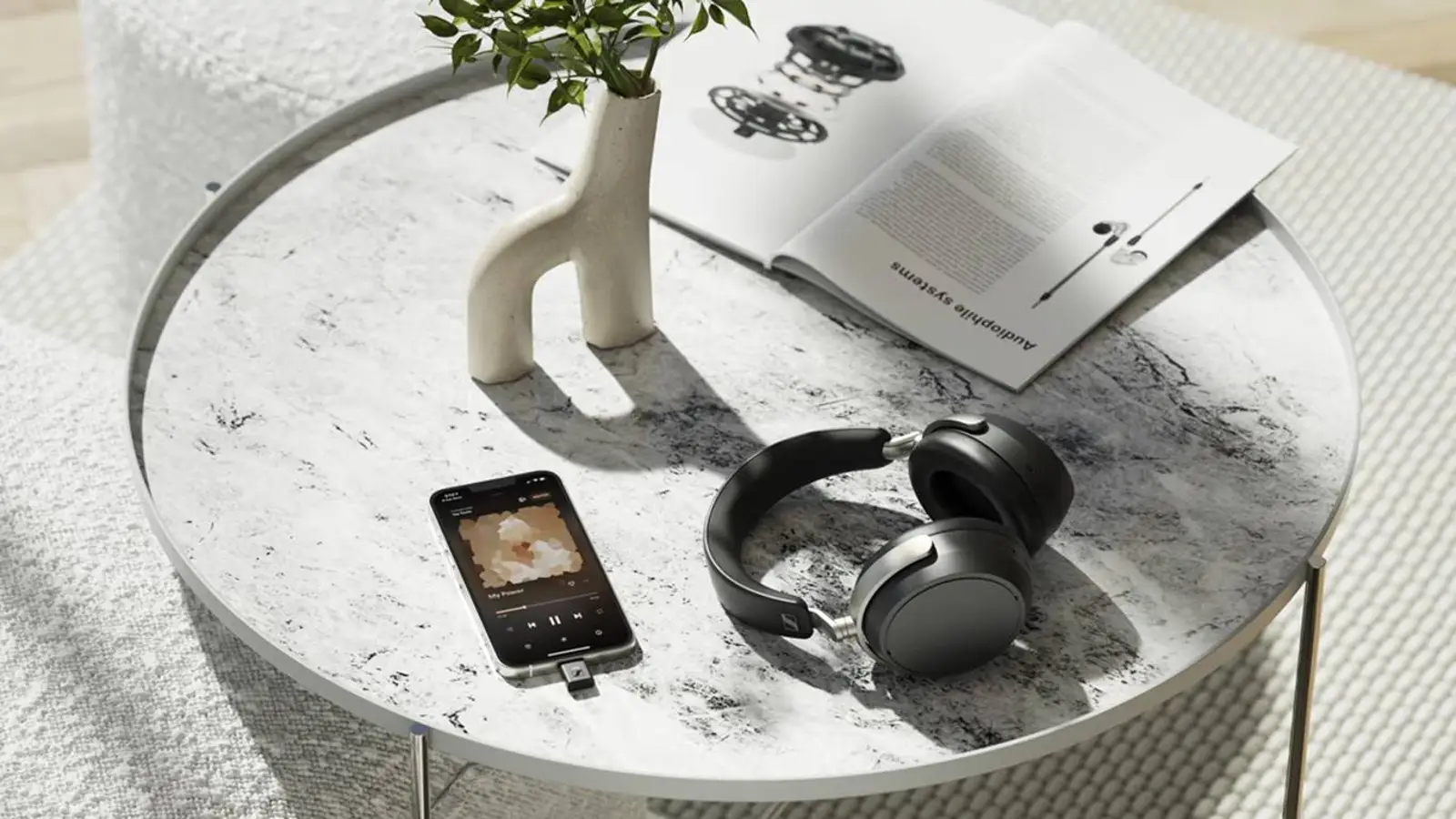
The Sennheiser HDB 630 represents a rare attempt to bridge two worlds: high-quality wireless audio and the Apple ecosystem, which traditionally ignores the aptX codec. The German brand approached this challenge unconventionally, offering a solution that could appeal not only to audiophiles but also to everyday users who value comfort and versatility.
The standout feature of the HDB 630 is its support for two distinct wireless listening scenarios. These headphones work with both AAC, the standard for iPhone, iPad, and Mac devices, and the modern aptX Adaptive codec. The latter is enabled via the included USB-C BTD 700 dongle, which transforms any compatible Apple device into an aptX audio source. This setup allows users to choose between convenience and maximum sound quality depending on the situation.
In everyday use, the HDB 630 functions like standard Bluetooth headphones. AAC pairing is quick and seamless, making them ideal for walks, commutes, or workouts. However, plug in the dongle, and the sound character changes noticeably. When playing lossless or hi-res music, the headphones deliver more expressive dynamics, a richer midrange, and better detail. This difference is particularly evident with complex compositions where instrument nuances and soundstage depth matter.
In terms of design, the HDB 630 resembles the more affordable Momentum 4 model, but Sennheiser has refined the acoustic components, focusing on a cleaner midrange and precise high frequencies. Bass can be further enhanced through the proprietary Smart Control app, which includes a parametric equalizer for fine-tuning frequencies. This level of customization is uncommon in wireless headphones and a significant advantage for users who like to tailor their sound.
The active noise cancellation performs reliably. It handles low-frequency rumbles, such as airplane noise, exceptionally well. Higher-frequency noises typical of busy environments are suppressed less aggressively, meaning models like the AirPods Max and Bose QuietComfort Ultra still hold a slight edge in this area. However, those alternatives are more expensive and don’t offer an alternative codec for Apple devices.
Battery life is another strong point for the HDB 630. Without the dongle, they last up to 60 hours; with aptX Adaptive enabled, runtime drops to around 45 hours. This is more than sufficient for long trips or flights. The package also includes a sturdy case, an airplane adapter, a USB-C cable, and a 3.5 mm audio cable, making the HDB 630 genuinely versatile.
The only notable drawback is the somewhat non-intuitive process for switching between standard Bluetooth and the dongle connection. This might cause confusion initially, though it becomes clearer after the first setup, and the app allows quick source selection.
Overall, the Sennheiser HDB 630 isn’t just another pair of Bluetooth headphones but a thoughtful solution for those wanting to maximize streaming services on Apple devices. They cost more than mainstream models but offer a rare combination of sound quality, connection flexibility, and excellent battery life. For audiophiles unwilling to compromise, the HDB 630 justifies its price tag.